A whole new Meaning to Trashy Music

Taking out the garbage, in most cultures, is considered a relatively dry and simple affair. After a week of living in Taiwan, I can tell you that on this island getting rid of the trash is quite complicated and sort of like a party.

The first day at orientation we were warned that the garbage trucks in Taiwan do not stop and will alert you to their arrival with ice cream truck-like jingles. After multiple days of travel, I didn’t fully process these simple instructions. A few days later, my roommates and I were hanging out in the apartment when Fur Elise suddenly began playing over the complex’s loudspeaker. After exchanging brief looks of puzzlement, we all remembered the warning about the garbage. Scraping together our growing collection, we rushed down the elevators to find the better portion of our 21 floor building’s residents camped out on the steps. Surrounding them were hundreds of bags of garbage. A few minutes later, a big yellow truck pulled up on the street with song seemingly composed for the sole purpose of clashing with the Beethoven still sounding from the apartment. Jostling with the rest of the building, we ran up behind the truck as it slowed and tossed our few bags of trash into the back. Unfortunately, when my bag hit it made a quiet clang with the sound of glass on metal. I immediately received judging looks from three people nearby, and fled back up the stairs to my apartment.

Later that week at orientation we were told that in Taiwan it is necessary to sort all of one’s trash and recycling. This is more complicated than it first appears. Food waste, glass, paper, plastic, boxes, and regular trash must all be organized and compartmentalized. If anything is awry, its a hefty fine from the garbage man.

That explained the dirty looks. The next time Fur Elise echoed throughout the apartment we were ready and sorted. After making our way to the street, we were unexpectedly accosted by the building security guard. He told us we couldn’t use the garbage, which was naturally quite confusing. Eventually we realized that he wanted us to sort through our waste. Upon telling him it was already done he was taken aback. Regaining his composure, he started to walk away–but not before exclaiming that someone had informed him of our previous sorting mishap and it had not gone overlooked.

I’m now a little worried about his informants in the complex, but most of all I find the whole musical garbage truck process to be quite entertaining. I appreciate the efforts to protect the environment, as well as the apparent zeal at enforcement.

I posted a video above of the scene.

Making Friends in the Neighborhood

With a lot of luck and some help from the storm walls, my apartment survived Typhoon Saola unscathed. No windows broke and flooding was limited to a few spots in the kitchen and living rooms. After talking with local Taiwanese, it seems that it was a pretty average-sized typhoon for the area and its likely that I’ll see a couple more before the year is up.

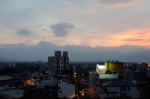
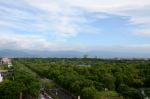
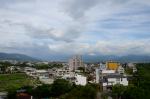
The weather since has been beautiful more for the most part, with giant sweeping clouds emerging over the mountains interspersed by pockets of blue sky and sunshine. It truly makes for some dramatic scenery, and a great view from my seventh floor balcony. The apartment is on the edge of a huge forest called the Luodong Sports Park. Its truly a comprehensive athletics center–complete with clay and concrete tennis courts, basketball courts, racquetball, outdoor swimming pools, workout equipment, a chess pavilion and taiqi stages throughout. Best of all, all of these features are free to the public and surrounded by gardens, a winding stream, and a lilly-filled lake. I couldn’t sleep a few nights back and ended up going for a prolonged run throughout the many trails of the forest. It was a literal breath of fresh air, and felt miles away from the hustle of the city just a few blocks away.

I’ve also started to get to know the area a little better, but this is a pretty difficult feat do to the fact that you never know what will be open in this town. I feel like I am playing a game of restaurant

roulette every time I step out of our front gate because a new store front will be open and one that was there just hours before will be closed. I still haven’t figured out the exact timing or days of each stores operation–I have only seen the ice cream shop next door open twice since arriving–but I’m at least getting used to the process. This is a major difference I’ve noticed with China, where shops are generally open at the same time every day with very extensive hours. The Taiwan way makes for some getting used to, but it definitely keeps things interesting.

A couple of days ago, I happened upon a dumpling (水餃)shop two doors down that I had never seen before. Upon entering I was greeted by a boisterous woman who proceeded to jab at my Beijing accent and mainland vocabulary while whipping up the best dumplings I’ve had in Taiwan yet. Since it was 3:00 on a Sunday, I was the only customer and the shop-owner sat down across from me. We talked for at least half an hour, and by the time I left she told me to call her Ayi–Auntie in Chinese. She also promised to teach me how to sound like a real Taiwanese and get rid of that telling accent of mine.

Looking back,  I’m not sure how much I want to gain a Taiwanese accent, but I do know I’m happy to have a friend in the neighborhood.

Typhoon Saola Strikes

I have to thank Typhoon Saola for the raucous welcome it gave as I stepped off the plane in Taoyuan airport. There’s nothing like 100 mph winds and a meter of rain to start off a good year.

I’m here through the American government’s Fulbright program, where I’ll be teaching English and completing independent research for the next year. My TPE to DCA ticket home is booked for August 1, 2013, and I can’t wait to see what experiences the next twelve months will bring. I’m living and working in Yilan County, a plain nestled between the central mountains and the Pacific Ocean, about 45 minutes outside of Taipei. It’s absolutely gorgeous, and on a good day (i.e. no typhoons) I should be able to see both the mountains and the ocean from my seventh floor apartment. Taiwan was originally named Ilha Formosa–beautiful island–by Portuguese explorers who discovered it in the 16th century, and it is easy to see why. The dramatic cliffs, sapphire-blue water, and tropical greenery make for a stunning sight.

For those of you who read my previous Beijing blog, I apologize for the infrequent posts and abandoning the blog halfway through the semester. I’m dedicated to keeping this one up to date throughout the entire year, and hope that it will be a good way for friends and family to have an idea of what I’m up to, and for me to record and remember some of my more interesting experiences.

The last few days have already been quite an adventure. On my flight over from Los Angeles, I sat between a Vietnamese nun and a eccentric woman who riddled me (as well as the English-limited nun) with sensationalist tales from her past including a supposed run-in with a great white in Perth where she escaped unharmed but her friend wasn’t so lucky…     At first this was rather entertaining, but after the first few hours of non-stop stories, I started to go a little crazy. I feel that there are definitely a few unwritten rules of airplane etiquette that this woman was breaking:

1. You don’t interrupt people when they are reading; 2. When people put their headphones on you generally don’t disturb them; 3. If someone turns to look out the window during a lull in conversation you don’t start up a whole new story.

I ended up having to fake sleep just to get some peace and quiet.

Since arriving in Taiwan life has revolved around the typhoon, which is currently a category 2 storm (equivalent to a cat 2 hurricane) and Yilan is currently in the eye of the storm. Last night, preparations involved rushing to the supermarket to pick up flashlights, water, and dry food for my new apartment, and subsequently realizing both how terrible my chinese has become and how terrible it is to be illiterate. While Taiwan speaks more or less the same mandarin as mainland China, the writing system is a lot different. In the 1960s China moved to a simplified form of Chinese characters while Taiwan and Hong Kong did not. Some characters are the same, but the majority of them look extremely different. Trying to figure out what type of batteries were needed in the new flashlight while rushing to get home before the roads get flooded out was quite an adventure. My roommates and I were mostly successful, but we did find out this morning while making scrambled eggs that the jug of milk we bought last night was actually a jug of yogurt.

The winds and rain have been pretty intense overnight and into today, but things have held up pretty well. It seems that the buildings are built quite sturdily and have some great extra features. Some of the coolest are the storm walls–metal barricades that can be pulled down over glass windows and sliding glass doors. Nerdily enough, lowering them last night when the 130 mph wind gusts started hitting was quite a fun time. I felt like I was in Star Wars ordering the blast doors to be closed before the storm troopers busted in.

Luckily, beyond lots of flooding and some collapsed billboards the area around our apartment is doing pretty well. Wish me luck for the second half of the storm, and I’ll be posting again soon when the storm lets up.

Time Flies – October to December

So, it’s be a long time since I last posted and life has changed quite a bit. One of the reasons that I’ve had so little time is that a few weeks after Huangshan, life started taking off in Beijing. I can’t believe the semester is already over, and it’s just been a ridiculous adventure up ‘til this point. About a month into the program—right after the Huangshan trip—I was feeling really down about my Chinese and in a somewhat hopeless mood. While I could understand simple phrases and respond as such, it still felt entirely foreign and removed. It was also around that time when I got my first case of what I call Mao’s Revenge or food poisoning. Needless to say, being down mentally and physically made for a pretty terrific combo.

Somewhere between then and now, things have dramatically changed. I made some terrific Chinese friends from a University about ten minutes away from Beijing University, and hanging out with them every weekend has hugely affected my experience. Although we have class every day from 9 to 5, you truly can’t get anywhere near proficient from that kind of environment.  Spoken language is natural and fluent, and especially in Chinese, does not much resemble the written form. Although I still don’t understand quite a bit of what my friends say among themselves, the situation is dramatically improving, and I’m really excited about the level I’m getting to. I’ve also been introduced to the real life of college students in China. Sometimes as westerners in our westerner-only program, we can easily live within a bubble. I have always wanted to avoid this as much as possible, and making good Chinese friends has allowed me to gain so many insights into Chinese society and young peoples views that I would have never been able to see otherwise.

All of December I’ll be traveling. We’re leaving next week for a two-week program trip to Xian, Luoyang, Chengdu, Sichuan, and Guilin. After that, a friend and I are ourselves exploring Guangxi, Guangzhou, Hainan, Hong Kong, and Macau before I head back to Beijing to meet my family.

Some things I’ve been up to as of late:

1. Drove for the first time in Beijing (It is quite a scary experience, and I would not recommend it)

2.  Hiked the Great Wall.

3. Started talking to a man in a café about Beijing, before I knew it he gave me his book with a signed message wishing me well, along with his business card. The restaurant owner then told me the man was an extremely famous Chinese economist.

4. Ate bull-frog. Actually quite tasty.

5. Was invited to a birthday party of Beijing’s 福儿代 (young twenty somethings’ whose parents are Beijing’s elite) where the birthday cake was as big as my bed.

6. Got a haircut at a Chinese place, and it turned out very very bad.

7.  Had thanksgiving dinner in a Western-Asian Fusion restaurant where we were served chilled red wine, they didn’t understand when we asked for a room-temperature one, responding—why would you want warm wine?

8.  Traveled through the ruins of the old summer palace.

9. Saw the national flag raising at Tiannanmen Square, followed by a visit to Mao’s tomb.

10.  My hands caught on fire for ten seconds, received some burns, but all-in-all turned out okay.

11. Started learning Chinese minority dances (My friends are students at Chinese Dance Academy).

12. Learned how to cook my first Chinese dish:  Eggs and Tomatoes. Simple, but delectable!

13. Made a 人人 (Chinese Facebook) account.

Hard Seats from Hell

Because it was a holiday weekend, almost all train tickets sold out weeks in advance, so we were stuck with 4th class tickets—called “Hard Seats”—on the slowest 18-hour train back to Beijing. Now this normally wouldn’t be terrible. Yes the seats are small, hard, 90 degree-angled, and cramped, but I enjoy meeting Chinese people and experiencing how the majority of the country travels. The seats are perfectly set up for communication. On each side of the aisle are two groups of 3 seats which face each other over a small table. You can play cards, eat together, or simply have a nice conversation over a cup of tea. On the train to Hefei, we befriended a whole group of Chinese and had talked about topics ranging from Desperate Housewives–which is extremely popular in China–to Taiwan and Tibet. But this time was different—very different.

The woman sitting across from me had a baby clothed in an outfit with a large slit opening in the underside in place of a diaper. Now this is pretty common to see in China because of the expense of diapers. What I didn’t expect was that instead of bringing the baby to the bathroom, she would simply hold it out over the miniscule space between both our legs when she sensed the baby was about to pee. And pee it did, all over the floor—countless times.

The first time it happened, we three of us Americans were completely shocked, and freaked out. The three of us (the two others had dropped the big money for a flight) jumped up, cursed in English. The other Chinese around us were also in a ruckus, but I couldn’t tell if they were just as shocked or if they just found the whole scene hysterical. We eventually collected ourselves and proceeded to ask her in Mandarin if she could bring her baby (baobao) to the bathroom. Her only response was “No can do.” At this point we were very confused, and while it didn’t seem right that this could actually be acceptable behavior, when living in a foreign country you always have to keep in mind that you operate by the rules and customs of that country, not your own. All we could do was accept it. I’d gone from the heavens of Huangshan to the train ride from hell in a matter of hours.

The first time the mother had the decency to tell us to move our bags of food to the side, but the second she didn’t bother, and by the third or fourth, the entire floor was soaked anyway and the cabin reeked, so it hardly mattered. Worse yet, the only place I could fit my legs was directly in baby-excrement ground zero. Because of this, I couldn’t sleep. If I didn’t keep baby-watch, I wouldn’t be able to swing my legs under my friend Amanda’s in time to avoid the frequent excretions. My acid reflux was acting up from all the MSG in the train food, and my back was killing me due to two days of hiking with a heavy pack, and countless hours seated at an awkward angle trying to dodge the baby. We also couldn’t leave our seats, because the entire aisle was filled with “standing room only” ticketholders and their luggage. A little kid who I had played with at the beginning of the hellish journey—and whose parents were God knows where—kept poking me with an antenna whenever I managed to shut my eyes. My breaking point came when the mother dropped her coat into the cesspool, and she proceeded to pick it up and shake it off over me.

That was the first time since coming to China I truly wanted to leave, and be back in the comfort and familiarity of the United States. Not being able to communicate properly, not knowing what was socially acceptable, not fully understanding the cultural norms was entirely overwhelming. If I ever experienced what’s known as culture shock, it was then and there.

The rest of the train ride was a sleepless blur, and I arrived back in Beijing safe but not quite so sound. Luckily, after immediately collapsing into my bed I awoke in the morning recharged and ready for another adventure.


Journey to the South

This last week was China’s National Holiday, 国庆节,a celebration similar to our 4th of July except that the vast majority of Chinese return to their families. To me, it meant that I had no class from last Friday ‘til this Thursday. A few friends and I decided to use this time to travel down to Anhui province (Southwest of Shanghai), which prides itself both on being most representative of “authentic” China, and having some of China’s most stunning landscapes. The most famous of these is 黄山,Huangshan(Yellow Mountain). It is generally regarded as China’s greatest beauty, and after visiting, I whole-heartedly agree. It may be the most awe-inspiring place I have ever been. The mountain was quite the climb, but getting there and back was an even greater challenge—and the fact that half of China joined us in holiday travel didn’t help matters.

Spontaneous, do-it-yourself travel is a gamble in any foreign country, but in China, it borders on crazy. Being five poor university students, we opted for trains instead of planes, hostels instead of hotels, buses instead of taxis, and poorly drawn maps instead of tour guides. While this led to a good deal of uncertainty, mistakes, problems, anxiety, and sometimes even fear, it was also made for an epic adventure.

After a 13 hour train ride from Beijing to Hefei in hard seats (will elaborate later), and a four hour bus ride from Hefei, we arrived in Huangshan locality. After scouring the city for, negotiating a price, and finally securing a cheap motel room, we headed off to a famed reserve called the Emerald Valley. Here we zip-lined above the jungle, and hiked deep into a crevice carved by a mountainous river. The area was stunning, lined with waterfalls, rapids, and pools of emerald water. As it approached dusk, and we traveled farther into the canyon, we were eventually the only people within sight. After camping out on a rocky outcrop, swimming through a cave to a hidden waterfall, and marveling at the setting sun, we journeyed back to our motel to prepare for the next day’s climb.

From the base of Huangshan to about ¾ up the mountain there runs a cable car which the vast majority of visitors take to ease the journey. Our group decided to do it the old-fashioned way and hike the trails from the bottom up. As the only ones climbing up the mountain we received numerous stares and comments from the mass of Chinese descending down the same paths. Assuming we couldn’t understand, they said some pretty entertaining things. One ancient man shouted “Nimen Feng le! FENG LE!!!” (You’re all crazy) about 20 times as he passed. It resembled a generic scene from a horror film, where the ignorant protagonists are warned to stay away. Another woman muttered “You’d think Americans could afford the 100 kuai for the cable-car…”.

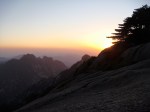
Seven hours later, we reached the very top of the mountain in time to see the distant peaks swallow the sun in a brilliant pallet of pinks, purples, oranges, and reds. In matter of minutes, the temperature dropped thirty degrees. Too cheap to pay thousands of kuai for a room, we settled for talking a guard into letting us sleep in the hallway of a mountaintop cabin motel.

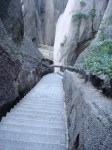
Leaving before the break of dawn, we hiked down into an alpine valley known as the Sea of Heaven where three streams converge in a cascade of waterfalls, and then proceeded to cross the great exposed-granite cliffs of the Western Sea. The highest reaches of the mountain resembled a cross between Lord of the Rings’ “Middle Earth” and Lion King’s “Pridelands” as we passed over bridges of intricate stone, and literally wound our way along valley walls. If you have a bucket list, I would recommend adding Huangshan right at the top. I was in state of awe and euphoria until we finally descended later the next day. I would need it for the train ride back to Beijing.

Beaches, Brides, and Beer

I just returned from the beautiful coastal city of 青岛 Qingdao. It is famous throughout China for its quaint German architecture and for being the birthplace of Tsingtao beer. A few friends mentioned they were going, and I jumped on the opportunity. Beijing is suddenly starting to get a chilly, and I couldn’t turn down the chance for beaches, sun, and quality beer.

Friday after class, we rushed off to take what would be my first Chinese train. It was a surprisingly pleasant experience. Because I purchased my tickets after the rest of the group, my seat was two train cars away. While at first I was disappointed, it was actually a blessing in disguise.  I offered the man sitting next to me one of my snacks, and in no time we were talking up a storm. By the time the train pulled in to Qingdao station, we were good friends and he had invited me to visit his home in Nanjing if I were ever in the area. One of my favorite things about China is how open and friendly complete strangers are if you break through the initial layer of formality.

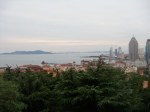
I met up with my other friends and we set out to explore Qingdao. Despite having 7,000,000 people, Qingdao still retains a small fishing town ambiance. Whereas Beijing’s every street corner overflows with people, Qingdao is relatively peaceful. It is a town perched on and nestled into hills that roll into the rocky Yellow Sea. Countless stands sell wild pearls harvested straight from the sea, and a boardwalk winds a weaving path around the entire Qingdao coastline. It’s a very clean city, and because the Germans controlled it during the late 19th century, has very little traditional Chinese architecture. In fact, Qingdao projects a strange aura. When looking out across the red-roofed houses, German imperial-inspired buildings, and Protestant churches, you think you’re in Bavaria. Then you’re hit with the smell of stinky tofu and the catchy beat of the next Mando-pop tune, and you’re knocked back to the Chinese reality.

It was wonderful heading off to the beach, which was pleasantly uncrowded because all of the Chinese thought it was too cold to swim. You don’t know what cold swimming is unless you’ve been in Lake Tahoe, or January’s North Floridian Atlantic. Qingdao’s water was perfect, and the view was astounding. On one side, steep cliffs of granite, on the other, towering ultra-modern skyscrapers. It was quite a site to behold. Even more fun than swimming were the beachside bumper cars. I don’t think American regulations allow bumper cars that accelerate so fast or hit with such force. I had a terrible headache by the time I stepped out, but it was by far the best bumper car experience of my life.

Qingdao did have some peculiar oddities. On the beach, we witnessed the filming of a Chinese game show that looked very similar to MXC (Most Extreme Elimination Challenge). At one point, a team of four trying to run a relay race in giant snow skis collapsed into a jumbled pile. It was a highly entertaining sight. Qingdao also seems to be a magnate for the “Wedding Photography” market, in which recently married couples go to beautiful places to take pictures in wedding attire. This doesn’t sound all too strange until you realize the scale of the phenomenon. In one picture I took of a seaside cliff, I count twenty-seven wives fully decked out in wedding dresses.

At the end of the day, going to Qingdao was an extremely fun weekend. I truly feel that it is a one of a kind city. Somewhat absurd, but a great place nonetheless.

Life in Beijing

Adjusting to life and class in Beijing has been quite the experience, and I believe this may be my first day of relaxation since arriving. I have been dreading writing this post because of the overwhelming amount of things, people, and, sights I have encountered over the last month. I cannot possibly describe life in Beijing, but I will try.

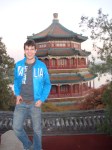
I am studying at Beijing University (Beijing DaXue), or Beida for short. Every day I have to remind myself of how amazing an opportunity this really is, because Beida is “The Harvard of China”. Not only is it the most prestigious university in China, it is also the most beautiful. Walking onto the campus, you’re greeted first by the largest library in Asia, built in a neo-Chinese imperial style. Before it was a university, Beida’s campus was the estate of a wealthy imperial official in the Qing Dynasty, so it is scattered with ancient trees, traditional oriental architecture, pagodas, quaint courtyards, and a picturesque lake.

This semester, my entire schedule is composed of Chinese language classes, and they are extremely strenuous. From Monday to Thursday I have class from 9:00am to 4:30pm with an hour and a half lunch break, and every Friday we have a test. My first day of class, I probably understood 15% of what my teacher said—and that’s being generous. It can definitely be discouraging studying Chinese, because it feels like such a monumental and impossible attempt. It’s a rough road, but last week I’d say I understood 85 to 90% of class, and that improvement keeps me going.

My apartment is a 30 minute speed walk from campus on the 11th floor. The complex is really interesting because between every building is a small park with workout equipment where people regularly congregate. Every morning, I pass by elderly Chinese practicing Taijiquan—a sort of daily exercise—and sometimes strike up conversations. It’s a very nice place by Chinese standards, but it’s not without its problems—mainly involving the bathroom. I literally have to crouch to take a shower, considering it was made for someone a foot shorter than me. The water pipe broke and flooded three times since I arrived, and I have to manually refill the toilet with water every time I flush.

The apartment’s neighborhood—called Wudaokou—has so much to offer. It has a subway line, countless restaurants, bars, clubs, cafés and stores. The wide sidewalk functions as a street market and the district is littered with street vendors selling all manner of apparel, trinkets, and best of all food. I have developed an intense love for Beijing’s street food. Not only does it usually cost only two or three kuai for a meal (35 to 40 cents), but the food is simply addictive. Some of my favorites are: Baozi (steamed dumplings filled with your meat of choice), Jianbing(thin pancakes filled with pork, spices, fried egg and sauce), roasted sweet potatoes, candied fresh fruits, and chuanr(marinated and grilled skewers of meat or vegetables). There’s no better way to start your day then to grab five pork baozi for the walk to class.

Because of the 30 minute walk, I decided to invest in a bicycle. Now, you may think I’m crazy for attempting to bike through the chaos that is Beijing—and you’re probably right—but boy does it make life easier. While I fear for my life every time I hop on, since dropping 290 kuai (45 dollars) for a new bike, I’ve been able to explore Beijing like never before—and sleep 30 minutes later every day.

Living in Beijing is a little unnerving because you never know what to expect. Every day is another mini adventure. Here are a few random experiences I’ve encountered or things of done:

– Hiked a mountain around the Great Wall.

– Joined the Beida Volleyball Team

– Unwittingly ate dinner with the Triad crime ring

– Sang KTV(Chinese Karaoke) with

– Watched a snake be slaughtered and served on the street

– Learned a hacky sack game called Jianzi

– Inadvertently told someone I wanted to kiss (pronounced wen with an up tone) them when I really meant I wanted to ask (pronounced wen with a down tone) them a question. Sometimes I hate Chinese tones.

– Taught a crowd of Chinese how to do the Macarena

– Used my terrible Korean skills to get free Danishes and laundry

– Tried Baijiu—the 57% alcohol traditional Chinese hard liquor

– Enjoy 60 kuai (10 dollar), 90 minute massages.

– Befriended an elderly Chinese woman in my apartment block.

– Been asked by way too many Chinese if “I curl my hair every day”.

– Every other day get told I look like some Russian tennis champion

– Accidentally ate “meat floss”. It’s like pork cotton candy.

There are many more, but right now I don’t remember. This weekend I’m off to Qingdao—a beautiful coastal city.  I’m determined that my next post won’t take a month to write.

The Venice of China

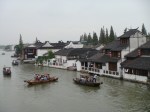
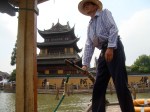
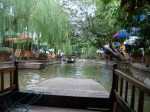
Today we drove out to Zhujiajiao–a two thousand year old water town full of ancient canals, and bridges. They even have gondola-like Chinese boat taxis that navigate the breathtaking waterways. At their temple, I sounded a giant gong that echoed throughout the town for good luck. Soon after, I was convinced by an eager official to double my fortune through an ancient tradition of throwing coins through a small hole to hit a bell in the temple courtyard. I missed it by a hair in the end, I couldn’t quite understand him but I either gained a little fortune for my valiant effort, or lost it all through my failure.

On another note, I finally decided on a Chinese name. Li Hao Ran (李浩然). In China, the surname (our lastname) comes first and the given name (two syllables) comes second. I chose Li because it’s the closest thing to Livingston in one syllable. The character Hao came from my Chinese immigrant student in the U.S. who I was tutoring in English. She told me that she loved the character hao and that it seemed to fit me well. Ran came from Amanda’s cousin in Shanghai. I mentioned to her I was looking for a name, and the next night she came to me before I went to bed with a whole list of research on different characters. This is just one example of how amazing and welcoming the Chinese people I’ve met so far have been. Anyway, she helped me to find rong as a good match for the rest of my name and personality. Together, my name means “Vast”, which I think is pretty cool. I’ll no longer have to spend five minutes trying to explain how to say “Grant” to every person I meet, which is even better.

Learning from lines

Just got back from a a journey up to the top of the Pearl Tower. It’s a radio tower on steroids that looks like its straight from the year 2100. It dominates the skyline, despite being the shortest of the mega-scrapers that dot the Pudong peninsula. We waited in line for three and a half hours to take an elevator up to the top where there’s an observation deck with a glass floor. It’s an amazing view, but the real story was the line that wrapped around the building three times.

Standing in line was a battle. An epic three hour long struggle to hold our ground and resist the never ceasing attacks of an old man, his hefty wife, and their twenty-orso year old grandson to squeeze in front of us. Amanda and I made a pretty solid barrier for about two hours and fifty six minutes. But with the elevator in sight, my back was hurting so I leaned against the wall. Three seconds later, the man had jumped between us and wedged himself in the foot of space between Amanda and the Japanese tourists in front of us. I couldn’t believe it. Then, the doors opened to the elevator and the crowd surged forward–fighting to get on. If you know me well, you know that I don’t let these sort of things slide. I reclaimed my position to block the rest of the family, but it was of no use. I was bulldozed over and had to wait for the next elevator. Not that the three minutes mattered after three hours, but it was the principle. I was not yet tough enough for China.

Strangely enough. this sort of thing isn’t uncommon. Waiting in line is the same as walking down the street, or driving for that matter. Everything seems competitive and somewhat chaotic. I think it might derive from the ultra concentrated and massive amount of people. When in public, there is no such thing as personal space, and you have to fight to get on the subway, find a taxi, or get assistance.

Driving is scarier than in Napoli–which is saying a lot. Oncoming cars will randomly enter your lane only meters from you, and your only option is to quickly swerve into the median, the shoulder, or something else. Also, a three lane highway will routinely have four or even five rows of cars. in China, the shoulders, lanes, and traffic signals are only suggestions rarely followed. In the states, a car will generally stop if its a good distance away and its going slow when you’re crossing a road. In China, they will speed up.

Although entirely different from anything I’ve ever experienced, I’m already getting used to it. Something about myself that’s always bothered me is that whenever  I brush or slightly bump into someone, I always say “sorry”. Since I got to DC two years ago I wanted to stop this because in the needlessly bitter east coast the people would look at me with the expression of “yeah, you should be”. Then I would be angry that I had said anything at all. After a few days in Shanghai, I’m a changed man. I knock into someone, and I keep on walking.

Design a site like this with WordPress.com
Get started