

This last week was China’s National Holiday, 国庆节,a celebration similar to our 4th of July except that the vast majority of Chinese return to their families. To me, it meant that I had no class from last Friday ‘til this Thursday. A few friends and I decided to use this time to travel down to Anhui province (Southwest of Shanghai), which prides itself both on being most representative of “authentic” China, and having some of China’s most stunning landscapes. The most famous of these is 黄山,Huangshan(Yellow Mountain). It is generally regarded as China’s greatest beauty, and after visiting, I whole-heartedly agree. It may be the most awe-inspiring place I have ever been. The mountain was quite the climb, but getting there and back was an even greater challenge—and the fact that half of China joined us in holiday travel didn’t help matters.
Spontaneous, do-it-yourself travel is a gamble in any foreign country, but in China, it borders on crazy. Being five poor university students, we opted for trains instead of planes, hostels instead of hotels, buses instead of taxis, and poorly drawn maps instead of tour guides. While this led to a good deal of uncertainty, mistakes, problems, anxiety, and sometimes even fear, it was also made for an epic adventure.
After a 13 hour train ride from Beijing to Hefei in hard seats (will elaborate later), and a four hour bus ride from Hefei, we arrived in Huangshan locality. After scouring the city for, negotiating a price, and finally securing a cheap motel room, we headed off to a famed reserve called the Emerald Valley. Here we zip-lined above the jungle, and hiked deep into a crevice carved by a mountainous river. The area was stunning, lined with waterfalls, rapids, and pools of emerald water. As it approached dusk, and we traveled farther into the canyon, we were eventually the only people within sight. After camping out on a rocky outcrop, swimming through a cave to a hidden waterfall, and marveling at the setting sun, we journeyed back to our motel to prepare for the next day’s climb.
From the base of Huangshan to about ¾ up the mountain there runs a cable car which the vast majority of visitors take to ease the journey. Our group decided to do it the old-fashioned way and hike the trails from the bottom up. As the only ones climbing up the mountain we received numerous stares and comments from the mass of Chinese descending down the same paths. Assuming we couldn’t understand, they said some pretty entertaining things. One ancient man shouted “Nimen Feng le! FENG LE!!!” (You’re all crazy) about 20 times as he passed. It resembled a generic scene from a horror film, where the ignorant protagonists are warned to stay away. Another woman muttered “You’d think Americans could afford the 100 kuai for the cable-car…”.
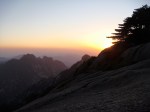
Seven hours later, we reached the very top of the mountain in time to see the distant peaks swallow the sun in a brilliant pallet of pinks, purples, oranges, and reds. In matter of minutes, the temperature dropped thirty degrees. Too cheap to pay thousands of kuai for a room, we settled for talking a guard into letting us sleep in the hallway of a mountaintop cabin motel.
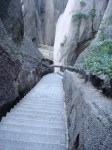
Leaving before the break of dawn, we hiked down into an alpine valley known as the Sea of Heaven where three streams converge in a cascade of waterfalls, and then proceeded to cross the great exposed-granite cliffs of the Western Sea. The highest reaches of the mountain resembled a cross between Lord of the Rings’ “Middle Earth” and Lion King’s “Pridelands” as we passed over bridges of intricate stone, and literally wound our way along valley walls. If you have a bucket list, I would recommend adding Huangshan right at the top. I was in state of awe and euphoria until we finally descended later the next day. I would need it for the train ride back to Beijing.
 Muddled