

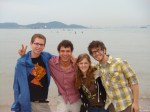



I just returned from the beautiful coastal city of 青岛 Qingdao. It is famous throughout China for its quaint German architecture and for being the birthplace of Tsingtao beer. A few friends mentioned they were going, and I jumped on the opportunity. Beijing is suddenly starting to get a chilly, and I couldn’t turn down the chance for beaches, sun, and quality beer.
Friday after class, we rushed off to take what would be my first Chinese train. It was a surprisingly pleasant experience. Because I purchased my tickets after the rest of the group, my seat was two train cars away. While at first I was disappointed, it was actually a blessing in disguise. I offered the man sitting next to me one of my snacks, and in no time we were talking up a storm. By the time the train pulled in to Qingdao station, we were good friends and he had invited me to visit his home in Nanjing if I were ever in the area. One of my favorite things about China is how open and friendly complete strangers are if you break through the initial layer of formality.
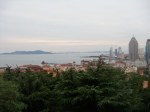
I met up with my other friends and we set out to explore Qingdao. Despite having 7,000,000 people, Qingdao still retains a small fishing town ambiance. Whereas Beijing’s every street corner overflows with people, Qingdao is relatively peaceful. It is a town perched on and nestled into hills that roll into the rocky Yellow Sea. Countless stands sell wild pearls harvested straight from the sea, and a boardwalk winds a weaving path around the entire Qingdao coastline. It’s a very clean city, and because the Germans controlled it during the late 19th century, has very little traditional Chinese architecture. In fact, Qingdao projects a strange aura. When looking out across the red-roofed houses, German imperial-inspired buildings, and Protestant churches, you think you’re in Bavaria. Then you’re hit with the smell of stinky tofu and the catchy beat of the next Mando-pop tune, and you’re knocked back to the Chinese reality.
It was wonderful heading off to the beach, which was pleasantly uncrowded because all of the Chinese thought it was too cold to swim. You don’t know what cold swimming is unless you’ve been in Lake Tahoe, or January’s North Floridian Atlantic. Qingdao’s water was perfect, and the view was astounding. On one side, steep cliffs of granite, on the other, towering ultra-modern skyscrapers. It was quite a site to behold. Even more fun than swimming were the beachside bumper cars. I don’t think American regulations allow bumper cars that accelerate so fast or hit with such force. I had a terrible headache by the time I stepped out, but it was by far the best bumper car experience of my life.
Qingdao did have some peculiar oddities. On the beach, we witnessed the filming of a Chinese game show that looked very similar to MXC (Most Extreme Elimination Challenge). At one point, a team of four trying to run a relay race in giant snow skis collapsed into a jumbled pile. It was a highly entertaining sight. Qingdao also seems to be a magnate for the “Wedding Photography” market, in which recently married couples go to beautiful places to take pictures in wedding attire. This doesn’t sound all too strange until you realize the scale of the phenomenon. In one picture I took of a seaside cliff, I count twenty-seven wives fully decked out in wedding dresses.
At the end of the day, going to Qingdao was an extremely fun weekend. I truly feel that it is a one of a kind city. Somewhat absurd, but a great place nonetheless.
 Muddled